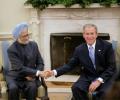
'The nuclear deal required Prime Minister Manmohan Singh to gamble the future of his government on a vision for the future of his nation.'

'An ardent advocate of nuclear disarmament, Obama may even be secretly heaving a sigh of relief that the NSG is unlikely to reach unanimity of opinion on India's candidature,' says Ambassador M K Bhadrakumar.

"He (Biden) is very much part of this period when Indo-American relations underwent a radical transformation, which I reasonably date back to (Bill) Clinton's visit," Jaishankar said.
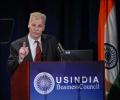
Ron Somers, president, US-India Business Council, which lobbied to get the US-India nuclear technology deal approved, like the rest of the American business fraternity, is upset by India's recent purchase of nuclear reactors and sophisticated technology and weaponry from Russia.

An obviously chagrined United States-India Business Council, which has lobbied feverishly for the passage of the US-India civilian nuclear deal in the US Congress, on Monday issued a guarded reaction to the passage of the nuclear liability bill in the Parliament that had 'compromised on the indemnity clause demanded by American companies to protect it from liability in case of a nuclear accident.'

In a tribute, President Joe Biden called him a "born patriot", while Indian External Affairs Minister S Jaishankar hailed him as a thought-provoking global strategist.

According to the Biden-Harris Transition, 'the president-elect noted that he looks forward to working closely with the prime minister on shared global challenges, including containing COVID-19 and defending against future health crises, tackling the threat of climate change, launching the global economic recovery, strengthening democracy at home and abroad, and maintaining a secure and prosperous Indo-Pacific region'.
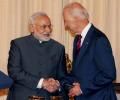
The two leaders agreed to work closely to further advance the India-US Comprehensive Global Strategic Partnership, built on shared values and common interests, it added.
US Commerce Secretary Carlos Gutierrez has said that with the signing of the historic and landmark US-India civilian nuclear deal it is now imperative that India move quickly to enact nuclear liability protection to envisage the private sector of both countries to engage in business.
Outgoing Ambassador Ronen Sen said on Sunday that the biggest legacy of the US-India civilian nuclear deal was not just civil nuclear cooperation that it would entail, but the restoration of trust between the two countries that was terribly eroded after Washington cut off nuclear fuel to India's Tarapur reactor following India first nuclear explosion in 1974.
There is growing concern in the American business and industry circles that despite their feverish lobbying to see the US-India civilian nuclear deal through, they may lose out to the French and the Russians -- who have already been provided sites by India -- while Americans firms wait for India to sign on to the International Convention on Civil Nuclear Liability, which these companies say is vital for them to protect their investments.

The six AP-1000 reactors would be built in Andhra Pradesh.
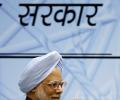
Former media advisor to Prime Minister Manmohan Singh Dr Sanjay Baru, the author of the controversial book 'The Accidental Prime Minister' that put Dr Singh in the dock over his alleged unassertiveness on policy issues, however points out that it was during the Indo-US nuclear deal discussions that the prime minister put his foot down and even staked his political future 'for the honour of commitment'. Bikash Mohapatra reports.
One of India's closest friends in the United States Congress, Representative Gary Ackerman, New York Democrat, on Tuesday asked Obama administration's point man for South Asia Robert Blake, as to what would happen if after the nuclear disaster in Japan, India may decide to forego the US-India civilian nuclear deal and rely more heavily on Iran for its energy requirements.

'China might soon have to seriously consider whether it prefers an Indo-US hyphenation to a Sino-Indian one.'

'The Modi visit will prove to be the watershed where India and the United States commenced technology trade and transfer.'
A nonproliferation hawk, who vehemently opposed the US-India civilian nuclear deal, former Congresswoman Ellen Tauscher will take over as Under Secretary of State for Arms Control and International Security.
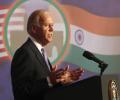
United States President-elect Joseph Biden has always been a strong supporter of India and India-US partnership since his days in Senate and later as a Vice-President.
Former Under Secretary of State Nicholas Burns, who was the star diplomat in the Bush Administration who negotiated the Indo-US civilian nuclear deal, has rubbished Pakistan's request for a similar accord saying the A Q Khan network was the mother of all nuclear technology proliferators and said Pakistan's concerns over India's involvement in Afghanistan are over-rated.
"The increasing strategic connections between the US and India should progress to closer military coordination and cooperation," Cohen said.
USIBC urged a serious evaluation of a more specialised bilateral economic arrangement.
Two nonproliferation hawks, who vehemently opposed the US-India civilian nuclear deal, will soon man the White House and State Department and lead the charge to push President Obama's non-proliferation agenda to seek a worldwide ratification of the Comprehensive Test Ban Treaty and a strengthening of the Nuclear Nonproliferation Treaty that is bound to bring pressure to bear on India that has been loath to sign the CTBT and has maintained the NPT is discriminatory.
Fast breeder reactors not up for inspection

'India must close the missile technology gap with both China and Pakistan as early as possible, or else the credibility of India's nuclear deterrence will remain suspect,' says Brigadier Gurmeet Kanwal (retd).
The USIBC calls for legislation and implementation of the plan that provides certainty in India's international tax treaties and investment structures.
US President George W Bush telephoned Prime Minister Manmohan Singh on Thursday during when the two leaders expressed a desire to move forward on the nuclear deal "as expeditiously as possible".
Indra Nooyi, the outgoing chairman of the US-India Business Council, said that the two of the major achievements during her tenure were the signing of the US-India civilian nuclear deal - where the USIBC played a catalytic role in garnering support on Capitol Hill - and the univocal support extended by the members following the 26/11 Mumbai terror attacks.

USIBC has seen exponential growth in the last five years, from just 80 companies as its members to now more than 350 top American companies, including scores of Fortune 500 and global Indian companies.
Daryl Kimball, executive director of the Washington, DC-based Arms Control Association believes India's expectation of a 'clean exemption' at the Nuclear Suppliers Group meeting scheduled for August 21 is "a fantasy".
In addition to mounting its own effort and putting in all its resources to convince the US lawmakers that the killer provisions of the comprehensive immigration reform bill -- that has been introduced in the Senate by the bipartisan group of eight Senators called the Gang of Eight -- the top business group representing the interest of US companies doing business in India is in the final stages of hiring a top lobbying firm for the purpose.
"Therefore, we have given our full support to the consolidation of a multi-party democracy in Afghanistan. We feel that it can and should be a multi-ethnic society, a plural society backed by the United States and India," Saran said.
The India-United States relationship has still not reached its full potential, though the two countries have developed steadily closer ties built on a uniquely strong foundation, according to powerful Senator Richard Lugar, a key supporter of the civil nuclear deal between the two sides. "The remarkable deepening of US-India ties over the past decade is only a start, as the relationship has still not reached its full potential," Lugar, ranking Republican.
Burns said, "What is paramount to any agreement is a country's obligations to its own laws, and so we have preserved -- as we must -- our obligations under US laws in this agreement."
In perhaps what could be his valedictory address before he departs from Washington when his terms expires on March 31, the Indian ambassador to United States, Ronen Sen--a key protagonist of the US-India civilian nuclear agreement--said the consummation of the deal freed India from "an albatross around our necks," in the form of nuclear technology and fuel isolation that worsened after India's May 1998 Pokhran nuclear tests.
Blake said, "What this visit will be remembered for is that it will mark really the first time that we have really embarked on serious, specific, global strategic cooperation in areas like open government, in areas like agriculture, or in women's empowerment, or in working together in Africa, working together in Afghanistan."
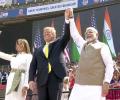
Trump's visit symbolised heightened partisanship and a return to chemistry between leaders defining bilateral ties, notes Kashish Parpiani.
American and Indian leaders will hold their third round of strategic dialogue talks in Washington, D.C., this week amidst growing concern that the US-India relationship is failing to live up to what US policymakers expected from it seven years ago, when the civil nuclear deal was first unveiled, writes Lisa Curtis.
Ashok Mago, chairman of the Dallas-based US-India Forum and a community leader, has been nominated for the "Apostle of International Understanding" by the Unity International Foundation for his "exceptional role in bring India closer to the US".
 © 2026 Rediff.com - Advertise with us - Disclaimer - Privacy Policy - Sitemap - Feedback - About us - Terms of use - Grievances